Clayborne Chavers
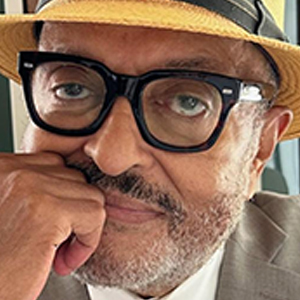
|
January 16, 1947 - December 22, 2025 Columbia (MD) Alumni Chapter of Initiation: Columbia (MD) Alumni (2017) |
|
Clayborne Edwin Chavers transitioned on December 22, 2025, after a prolonged illness following a traumatic brain injury. He was a father, husband, brother, artist, veteran, attorney, and a man whose presence filled rooms long before he ever spoke. Born in Philadelphia, Pennsylvania, Clay (or “Butchy” as his mother and older sister called him) was raised in a working-class Black family and came of age in a city that shaped both his grit and his contradictions. He attended Hanna Elementary School, Shoemaker Junior High School, and Overbrook High School, where he majored in Art. A brilliant artis,t Clay studied Fine Arts at Cheyney State College while still a senior in high school and enrolled as a freshman at the Pennsylvania Academy of the Fine Arts (now University of the Arts) in 1966, but was soon called to serve in the United States Army. Clay’s experience as a soldier broadened his world and sharpened his sense of discipline. While stationed abroad, including time in Eritrea, he taught art courses at the junior and senior level, earning recognition and awards for his portraiture. He remained, at heart, a visual artist—someone who understood the world spatially, intuitively, and emotionally. After returning home, Clay graduated from Howard University’s School of Law (BA, cum laude 1972; JD, 1975) and spent his life as a civil rights, arts, and entertainment attorney. Though the law was not his first love, he brought to it a sharp mind, persuasive instincts, and a deep belief in argument as a form of connection. His children fondly recall how he’d type with his two finger,s shouting out his children’s names whenever he wanted a proofreader. Even when he slowed down his practice in his later years, Clay never stopped engaging ideas as if they mattered urgently—because to him, they did. Clay began his legal career in federal government service during a formative period in American civil rights history. He served in the U.S. Department of Justice, including the Civil Rights Division, working on claims against federal agencies and addressing systemic discrimination. He also served with the U.S. Civil Service Commission (now the Merit Systems Protection Board), assisting in the adjudication of federal employment appeals, and worked with the National League of Cities, helping coordinate nationwide policy implementation, law enforcement training, and legislative initiatives. His federal work included involvement with the National Endowment for the Arts, where he addressed issues of arts funding, governance, and equity, particularly as they affected local arts councils and public accountability. During this period, Clay became a vocal advocate for diversity and fairness in cultural institutions, speaking publicly about inequities in arts funding and advising on compliance and reform. After leaving government service, Clay entered private practice and became a pioneer in arts, entertainment, and sports law. He was a founder and the first chairman of the Entertainment, Sports, and Arts Law Section of the National Bar Association, helping to establish the field as a recognized area of legal practice. He remained active throughout most of his career in the American Bar Association, District of Columbia Bar, Pennsylvania Bar Association, Washington Area Lawyers for the Arts, and the Black Entertainment and Sports Lawyers Association. Clay represented an extraordinary range of clients (national and internationally) across film, television, music, theater, publishing, radio, sports, and broadcasting. He served as general counsel to entertainment and media companies in New York City, New Jersey, and Washington, D.C., negotiated complex recording, publishing, and production agreements, and handled intellectual property, employment, and civil rights matters for artists, producers, broadcasters, estates, corporations, nonprofit organizations, and foreign governments. Alongside his entertainment practice, Clay continued his civil rights work, playing roles in significant discrimination cases, including matters involving Eastman Kodak, and advising institutions on employment law, inclusion strategies, and public accountability. He served on commissions, advisory boards, and steering committees in Howard County and the State of Maryland, contributing to arts policy, economic development, and equal opportunity initiatives. He was a charter member of Waring Mitchell Law Society. Education and mentorship were central to Clay’s identity. He served as an adjunct professor at Howard University School of Law and lectured widely on entertainment law, intellectual property, labor law, and civil rights. He also authored a detailed proposal for an Entertainment and Arts Law Clinic, envisioning a hands-on, interdisciplinary program that would allow students to represent real clients in the creative economy. The proposal reflected his belief that legal education should be experiential, ethical, and responsive to artists and cultural workers. Deeply social and drawn to brotherhood, Clay valued conversation, connection, and community. He was inducted into Kappa Alpha Psi Fraternity, Inc. in 2017 and, in 2019, was admitted to the Grand Boulé of Sigma Pi Phi Fraternity. Clay was the proud father of three children, Linda Doris Mariah Chavers, Catherine Mariah Chavers, and Clayborne Edwin Chavers, Jr. whom he loved deeply and whose lives brought him great joy. Though family life was complicated and often imperfect, fatherhood was central to how Clay understood himself. He worried constantly about whether he had done right by his children, whether they knew how proud he was of them, and whether they felt his love. They absolutely did and still do. He loved debating, laughing, and learning alongside his children, and was famous for his practical, unvarnished wisdom. To nearly every complaint, he would ask—earnestly and without irony—‘Did you poop?’ a question his children now remember with deep affection and increasing agreement. Clay married his best friend and love of his life, Susan, in front of loved ones and friends in their home in 2015. They enjoyed hosting friends and family in their home on numerous occasions. To know Clay was to know his laugh—loud, booming, unmistakable. It was an explosion of sound that carried warmth, humor, and a refusal to be small. He taught his children how to drive, how to argue, how to shake someone’s hand, and how to hold their ground in the world. He played Marvin Gaye’s What’s Going On in car rides and explained its political meaning with reverence. He called just to hear his children’s voices. He wrote letters when words were hard. He believed fiercely in his children’s intellect and ambition, long before they even did. Clay was a proud Black man and unapologetic in his political convictions. A lifelong Democrat, he believed deeply in justice, accountability, and the necessity of naming power plainly. When asked to respond to the familiar refrain, “When they go low…,” Clay’s answer was characteristically his own: “Bury them.” He despised bigotry with a passion. Clay did not mistake civility for morality, and he believed clarity was a form of integrity. He was not always an easy man, but he was a deeply consequential one. His presence shaped lives. His absence leaves a vast and complicated grief. He is survived by his beloved wife, Susan Elizabeth Carter Chavers; his children, Linda Doris Mariah Chavers, Catherine Mariah Chavers, and Clayborne Edwin Chavers, Jr.; his stepdaughter, Ambrosia Cruz; his former wives, Toni Laverne Shamwell, with whom he shared his daughter Linda, and Kathy Jackson, with whom he shared Catherine and Clayborne, Jr.; his siblings, Carrie Chavers-Wills, Donna Chavers, and Kevin Gerald Chavers; his sister-in-law, Ginger McKnight Chavers; his brother-in-law, Charles Wills; his nephews, William Edward Shipley IV and Zuri Chavers; his niece, Cameron Quinn Chavers; his niece-in-law Telene Nicole Shipley, his great-nephew, William Edward Shipley V, and his great-niece, Skye Nicole Shipley—along with many more family members, colleagues, friends, and former students who carry pieces of him forward. The family asks that you remember Clay as he was in motion—laughing loudly, arguing passionately, pontificating on a well-lived life, or driving with music turned up—always insisting on being felt. | |